

 English
 Français
 Español
See Details
- Residential Energy Storage

- C&I BESS

- Large-Scale Centralized Energy storage

- Solar Panel

- Power Inverters

- Vehicle Lithium Battery


Industry News
Home / News / Industry News / How to Choose Between Lithium-Ion and Lead-Acid Battery Storage Systems
How to Choose Between Lithium-Ion and Lead-Acid Battery Storage Systems
Content
- 1 Why Battery Chemistry Shapes Decade-Long Storage Costs
- 2 Depth of Discharge and Usable Capacity Compared
- 3 Cycle Life and Degradation Patterns
- 4 Energy Density and Installation Footprint
- 5 Safety Standards and Thermal Behavior
- 6 Maintenance Requirements Across Chemistries
- 7 Total Cost of Ownership: A Practical Framework
- 8 Choosing the Right Chemistry for Your Application
- 9 Frequently Asked Questions
- 9.0.1 Q1: Is lithium always the better choice for solar storage?
- 9.0.2 Q2: How much shorter is the lifespan of lead-acid compared to lithium?
- 9.0.3 Q3: Do lithium batteries need less maintenance than lead-acid?
- 9.0.4 Q4: Why does depth of discharge matter so much in cost comparisons?
- 9.0.5 Q5: Is lithium storage safe to install indoors?

Why Battery Chemistry Shapes Decade-Long Storage Costs
A backup power bank, a solar off-grid system, and a commercial peak-shaving installation all live or die on the same underlying decision: which battery chemistry sits inside the cabinet. A modern Lithium Energy Storage System behaves very differently from a flooded lead-acid bank once you look past the upfront invoice, and that difference compounds every single day the system operates.
Every Energy Storage System (ESS) Manufacturer today offers both chemistries side by side, which is exactly why buyers get confused. The sticker price on a lead-acid bank is almost always lower. The lifetime cost per stored kilowatt-hour is almost always higher. This article walks through the technical reasons why, using depth of discharge, cycle life, energy density, safety behavior, and maintenance load as the comparison points that actually determine total ownership cost.
The chemistry you choose on day one locks in your replacement schedule, your footprint, and your maintenance labor for the next five to fifteen years.
Depth of Discharge and Usable Capacity Compared
Depth of discharge (DoD) is the percentage of a battery's rated capacity that can be drawn down before recharging without materially shortening its life. This single number explains most of the price confusion between chemistries, because a battery's nameplate capacity and its usable capacity are not the same thing.
Typical DoD Ranges by Chemistry
| Chemistry | Recommended DoD | Usable Capacity per 100 Ah Rated |
|---|---|---|
| Flooded lead-acid | 50 percent | 50 Ah |
| Sealed / AGM lead-acid | 50 to 60 percent | 50 to 60 Ah |
| Lithium iron phosphate | 80 to 100 percent | 80 to 100 Ah |
In practical terms, a lead-acid bank rated at 200 Ah is often sized to deliver only 100 usable amp-hours if the installer wants to protect cycle life. A lithium bank rated at the same 200 Ah can reliably deliver 160 to 200 usable amp-hours. That means a system designer frequently needs to purchase nearly double the rated lead-acid capacity to match the real-world output of a lithium pack, which erases much of the initial price advantage before a single cycle has been logged.
Cycle Life and Degradation Patterns
Cycle life measures how many full charge-discharge cycles a battery can complete before its capacity falls to roughly 80 percent of its original rating. Lead-acid and lithium chemistries degrade on very different curves, and the gap widens the deeper each cycle discharges the battery.
The gap is not a marginal difference. A lithium bank commonly delivers five to ten times the number of full cycles that a lead-acid bank can sustain at the same discharge depth. For an installation that cycles daily, such as solar self-consumption, that difference translates into a replacement every fifteen years for lithium versus every two to three years for lead-acid.
Energy Density and Installation Footprint
Energy density determines how much floor space, wall space, and structural load-bearing capacity a project needs to set aside for storage. Lithium cells pack roughly two to three times the energy into the same physical volume compared with lead-acid, and they weigh substantially less per stored kilowatt-hour.
For rooftop, mezzanine, or space-constrained retrofit installations, this weight and volume difference is often the deciding factor before cost is even discussed. A commercial building retrofitting a battery room into an existing footprint may find that only a lithium configuration physically fits the available floor loading and ceiling clearance.
- Lead-acid banks typically require dedicated ventilated rooms due to gas off-gassing during charging.
- Lithium iron phosphate systems can often be installed in occupied spaces without the same ventilation infrastructure.
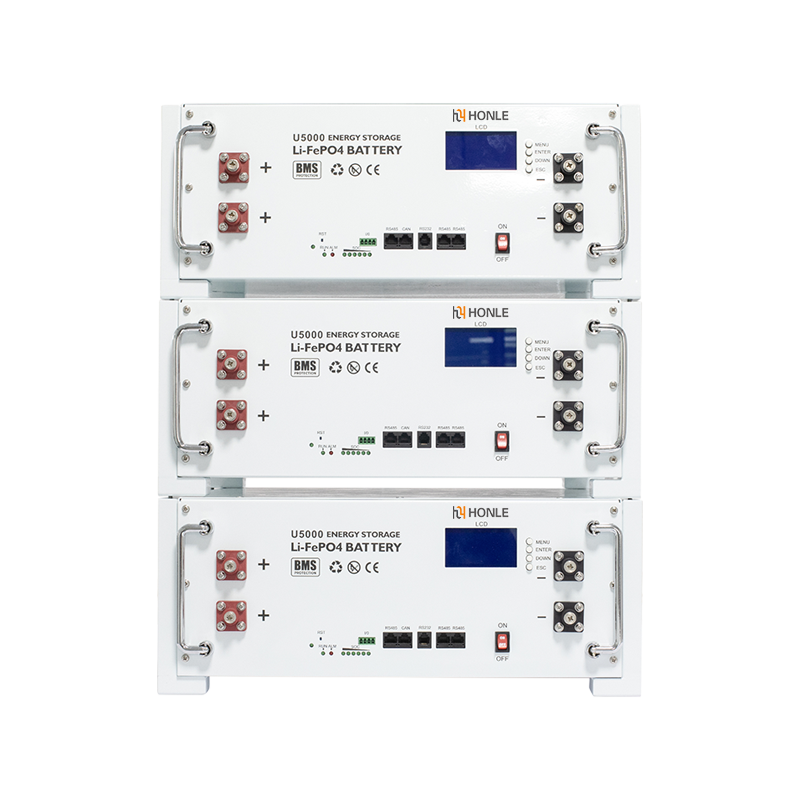
- Rack-mounted lithium modules allow vertical stacking that flooded lead-acid cells cannot safely support.
Safety Standards and Thermal Behavior
Safety comparisons between chemistries are often oversimplified in marketing material, so it is worth separating the real risk factors rather than treating one chemistry as universally safer.
Lead-Acid Risk Factors
- Hydrogen gas release during charging requires ventilation to avoid explosive concentrations.
- Sulfuric acid electrolyte poses spill and corrosion risk if the case is damaged.
- Thermal runaway risk is comparatively low under normal operating conditions.
Lithium Risk Factors
- Thermal runaway risk exists if cells are damaged, overcharged, or poorly managed, which is why battery management system quality matters as much as the cell chemistry itself.
- Lithium iron phosphate chemistry has a materially higher thermal runaway onset temperature than other lithium chemistries, which is why it dominates stationary storage applications.
- No off-gassing during normal charging, reducing ventilation requirements.
Certification bodies apply distinct testing standards to each chemistry, covering short-circuit response, overcharge protection, thermal abuse, and mechanical shock. Any storage system, regardless of chemistry, should carry documentation showing it passed the relevant abuse and safety testing for its intended application before installation.
Maintenance Requirements Across Chemistries
| Task | Flooded Lead-Acid | Lithium Iron Phosphate |
|---|---|---|
| Electrolyte water top-off | Monthly to quarterly | Not applicable |
| Terminal corrosion cleaning | Quarterly | Rarely needed |
| Equalization charging | Monthly | Not applicable |
| Capacity testing | Annually | Managed automatically by BMS |
| Ventilation inspection | Ongoing | Not applicable |
Sealed AGM lead-acid removes the water top-off requirement but still degrades faster than lithium and still benefits from periodic capacity verification. Lithium systems shift most of this monitoring burden onto the battery management system, which tracks cell balancing, temperature, and state of charge continuously rather than relying on manual inspection schedules.
Total Cost of Ownership: A Practical Framework
Comparing sticker prices alone misrepresents the real economics of a lithium ion battery vs lead acid battery decision. A more accurate framework divides the upfront purchase price by the number of usable cycles across the expected system life, then adds the maintenance labor and replacement freight and disposal costs over that same period.
Upfront Cost
Lead-acid typically costs less per rated amp-hour at time of purchase.
Cost per Usable Cycle
Lithium is usually lower once cycle life and usable DoD are factored in.
Replacement Frequency
Lead-acid commonly requires two to five replacements over the life of one lithium bank.
Labor and Downtime
Lithium reduces scheduled maintenance visits and unplanned outage risk from missed servicing.
Projects with short expected service lives, low daily cycling, or very tight capital budgets can still make sense for lead-acid. Projects with daily cycling, remote or hard-to-service locations, or footprint constraints tend to favor lithium once the full ownership period is modeled.
Choosing the Right Chemistry for Your Application
Space, ventilation access, budget flexibility, and how often the system actually cycles are the four questions worth answering before comparing quotes. A backup generator substitute that runs a handful of times a year has a very different economic profile than a solar system cycling every single day of the year.
Frequently Asked Questions
Q1: Is lithium always the better choice for solar storage?
Not universally. Daily-cycling solar systems generally favor lithium due to cycle life and usable depth of discharge, but very low-budget or rarely-cycled backup applications can still justify lead-acid.
Q2: How much shorter is the lifespan of lead-acid compared to lithium?
Flooded and AGM lead-acid typically last two to three years under daily cycling, while lithium iron phosphate commonly lasts ten to fifteen years under the same usage pattern.
Q3: Do lithium batteries need less maintenance than lead-acid?
Yes. Lithium systems rely on an internal battery management system for balancing and monitoring, removing the water top-off, equalization charging, and terminal cleaning tasks that flooded lead-acid requires.
Q4: Why does depth of discharge matter so much in cost comparisons?
Depth of discharge determines how much of the rated capacity can actually be used without shortening battery life, so ignoring it leads to underestimating how much lead-acid capacity is really needed to match a lithium system.
Q5: Is lithium storage safe to install indoors?
Lithium iron phosphate has a higher thermal runaway onset temperature and does not off-gas during normal charging, which is why it is commonly approved for indoor and occupied-space installations when paired with proper battery management and certified enclosures.
Related products
News
-
Honle New Energy Technology Participates in Industry Exhibition From September 8 to 10, 2026, Honle New Energy Technology Co., Ltd. partic...
READ MORE -
You have mounted solar panels, wired a battery bank, and installed an inverter. Yet your batteries never seem to reach full charge, or they...
READ MORE -
You have just received a higher electricity bill, and the sun is still shining outside. Can you actually use that free energy? Yes, but no...
READ MORE -
Allan just installed a 6 kW solar array on his workshop roof. The quote offered two choices: save $120 by accepting a modified sine wave i...
READ MORE -
The Wattage Number That Decides Everything Before you choose a portable power station, an inverter, or a solar array, the only number you r...
READ MORE

PRODUCTS
LINKS
CONTACT
- Landline: +86-021-56981116
- TEL: +86-13795289200
- Email: [email protected]
- Address: 301-09, Building 6, Zhangjiang Microelectronics Port, No.690 Bibo Road, Pudong District, Shanghai
Copyright © Honle New Energy Technology Co., Ltd.
All Rights Reserved.
Wholesale Solar Energy Equipment Suppliers

This site uses cookies. By continuing to browse the site you are agreeing to our use of cookies. For more details about cookies and how to manage them see our 《Privacy Policy》
Accept