

 English
 Français
 Español
See Details
- Residential Energy Storage

- C&I BESS

- Large-Scale Centralized Energy storage

- Solar Panel

- Power Inverters

- Vehicle Lithium Battery


Industry News
Home / News / Industry News / High Voltage vs Low Voltage Stackable ESS: How Do You Choose the Right Modular Battery Architecture?
High Voltage vs Low Voltage Stackable ESS: How Do You Choose the Right Modular Battery Architecture?
Content
- 1 Why Voltage Architecture Is the First Decision in Any Stackable ESS Project
- 2 High Voltage vs Low Voltage: Core Technical Differences
- 3 Visualizing the Two Stack Topologies
- 4 LiFePO4 Battery Technology and BMS Integration Across Voltage Classes
- 5 Energy Conversion Efficiency and Power Density Considerations
- 6 Hybrid Inverter Compatibility: Matching Voltage Architecture to Your System
- 7 Peak Shaving Performance: HV vs LV Under Real Load Conditions
- 8 Modular Expansion: Planning for Future Capacity Growth
- 9 Safety Certification and Regulatory Considerations
- 10 Total Cost of Ownership: Looking Past the Sticker Price
- 11 How to Choose: A Practical Decision Framework
- 12 Frequently Asked Questions
- 12.0.1 Q1: Is a high voltage stackable ESS always more efficient than a low voltage one?
- 12.0.2 Q2: Can I mix high voltage and low voltage modules in the same stack?
- 12.0.3 Q3: Does a low voltage stackable ESS require less certified installation labor?
- 12.0.4 Q4: How many modules can typically be added to a stackable ESS before hitting a limit?
- 12.0.5 Q5: Is LiFePO4 chemistry used in both HV and LV stackable systems?
- 12.0.6 Q6: What happens if my battery stack voltage falls outside my inverter's accepted range?

Why Voltage Architecture Is the First Decision in Any Stackable ESS Project
Every stackable ESS deployment eventually comes down to one structural choice that shapes everything else: will the battery stack operate at high voltage or low voltage. This single decision determines cabling complexity, safety protocol, inverter pairing, and how far the system can scale before running into diminishing returns. Installers and system integrators who treat this as a minor spec sheet detail often discover, mid-project, that it actually dictates labor hours, permitting requirements, and long-term maintenance costs.
A stackable ESS is built from repeatable battery modules connected in series or parallel to reach a target capacity. The voltage architecture determines how those modules communicate, how much current flows through the busbars, and how the battery management system coordinates cell balancing across the stack. Understanding the tradeoffs between the two approaches is the difference between a system that scales cleanly and one that requires a redesign after year two.
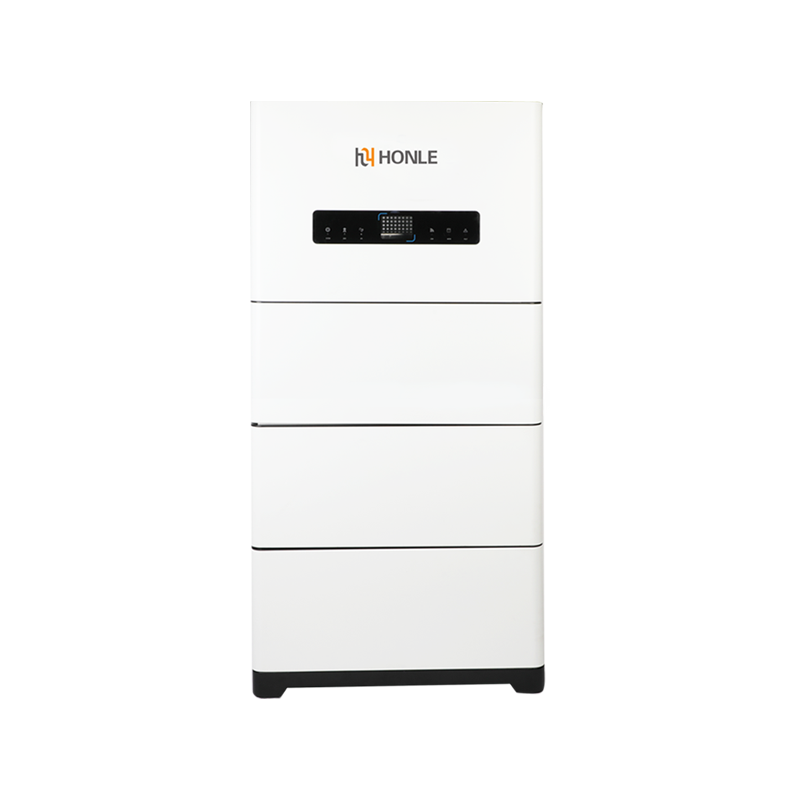
High Voltage vs Low Voltage: Core Technical Differences
The terms high voltage (HV) and low voltage (LV) in residential and light commercial energy storage generally describe stack voltage ranges rather than a strict engineering standard. LV systems typically operate in the 48V to 60V range per module or stack, while HV systems commonly reach anywhere from 150V up to 600V or higher depending on the number of modules connected in series. The table below summarizes the practical differences that matter most during system design.
| Parameter | Low Voltage (LV) Stack | High Voltage (HV) Stack |
|---|---|---|
| Typical Stack Voltage | 48V to 60V | 150V to 600V+ |
| Current at Equal Power Output | Higher current, thicker cables | Lower current, thinner cables |
| Cabling and Busbar Cost | Higher due to conductor size | Lower, smaller gauge required |
| Energy Conversion Efficiency | Slightly lower under heavy load | Generally higher at scale |
| Safety and Isolation Requirements | Simpler, lower shock hazard class | Stricter isolation, arc flash awareness |
| Typical Application Scale | Small residential, backup power | Whole-home, light commercial |
| Module Expansion Ceiling | Limited by current capacity | Higher headroom for growth |
Neither architecture is universally superior. LV stacks remain popular for smaller residential installs where simplicity and lower installation risk outweigh the efficiency gains of HV. HV stacks make more sense once total capacity climbs past the point where current-carrying conductors become bulky, expensive, or thermally limiting.
Visualizing the Two Stack Topologies
The diagram below illustrates how module count and wiring topology differ between a low voltage parallel stack and a high voltage series stack. In the LV configuration, modules are wired in parallel to preserve a stable low voltage while capacity grows. In the HV configuration, modules are wired in series, and voltage climbs with each added module while current stays comparatively low.
LiFePO4 Battery Technology and BMS Integration Across Voltage Classes
Both HV and LV stackable systems in the current market are built almost exclusively on LiFePO4 (lithium iron phosphate) cell chemistry, valued for its thermal stability, long cycle life, and predictable degradation curve compared to older lithium chemistries. What differs between HV and LV is not the cell chemistry itself but how the battery management system (BMS) is structured to monitor and balance it.
- Cell-level monitoring: Every cell group is tracked for voltage, temperature, and internal resistance drift regardless of stack voltage class.
- Module-level BMS: Each module contains a local controller that manages balancing within its own cell group and reports status upstream.
- Stack-level coordination: A master BMS aggregates data from every module, and in HV systems this layer also manages isolation monitoring across the full series string, since a single ground fault anywhere in a high voltage string can be harder to localize than in a low voltage parallel bus.
In practice, HV stacks place more responsibility on the master BMS because series-connected modules must stay balanced not just in charge state but in impedance, or the weakest module in the string becomes a bottleneck for the entire stack's usable capacity. LV parallel stacks are more forgiving here, since each module contributes independently to a shared bus rather than passing current through its neighbors.
A stack is only as reliable as its weakest module. In series-wired HV architectures, this principle has outsized consequences, which is why module-matching and firmware-level cell balancing deserve more attention during commissioning than they typically receive.
Energy Conversion Efficiency and Power Density Considerations
Efficiency differences between HV and LV stacks come down mostly to resistive losses. At a fixed power output, LV systems require higher current to deliver the same wattage, and resistive loss scales with the square of current. This means LV stacks generally show a modest efficiency disadvantage compared to HV stacks once system size grows beyond a few kilowatt-hours, though the gap narrows considerably at smaller residential scales where conductor lengths are short.
Typical Round-Trip Efficiency
LV stacks commonly land in the low-to-mid nineties percentage range under moderate load. HV stacks often edge slightly higher under the same conditions, primarily due to reduced conductor and connector losses.
Power Density Per Enclosure
HV architecture generally allows more energy to be packed into the same footprint, since thinner conductors and smaller connectors free up internal enclosure space for additional cell capacity.
Thermal Behavior Under Load
Lower current in HV strings means less resistive heating in cabling, which can translate to more stable module temperatures during sustained high-power discharge events such as peak shaving.
Power density matters most in space-constrained installations such as garages, utility closets, or multi-unit housing, where every additional centimeter of enclosure footprint has a real cost. Modular battery storage systems built on HV topology tend to offer a size advantage precisely because of these conductor and connector savings.
Hybrid Inverter Compatibility: Matching Voltage Architecture to Your System
Voltage architecture is not a decision made in isolation from the inverter. Hybrid inverters are generally designed with a target DC input voltage window, and pairing a battery stack outside that window either prevents operation entirely or forces the system to run below its rated efficiency. Before committing to a stack topology, it is worth confirming three things with the inverter's documented specifications.
- The minimum and maximum DC input voltage window the inverter accepts from the battery side.
- Whether the inverter supports dynamic voltage tracking as the stack charges and discharges, since stack voltage is not static across a full charge cycle.
- Communication protocol compatibility, since HV and LV battery stacks may use different CAN bus or RS485 configurations to report state of charge to the inverter.
Mismatched voltage windows are one of the most common integration failures in field deployments. A stack that sits even slightly below an inverter's minimum operating voltage at low state of charge will trigger premature shutdowns, while a stack that exceeds the maximum can trip protective disconnects. This is why voltage architecture should be finalized before inverter selection, not after.
Peak Shaving Performance: HV vs LV Under Real Load Conditions
Peak shaving, the practice of using stored energy to offset demand charges or grid draw during high-tariff periods, places different demands on HV and LV stacks. Because peak shaving events typically require a short burst of high power output, the current-handling characteristics of the stack architecture become directly relevant to performance.
| Scenario | LV Stack Behavior | HV Stack Behavior |
|---|---|---|
| Short high-power burst (under 5 minutes) | Higher conductor heating, may require derating | Handles burst with lower thermal stress |
| Sustained moderate discharge (1 to 2 hours) | Stable, efficiency gap narrows | Slight efficiency edge maintained |
| Frequent daily cycling | Simpler thermal management needs | Benefits from more headroom, less derating risk |
For households or small commercial sites with modest peak shaving needs, an LV stack sized appropriately for the load profile will typically perform without issue. Larger sites with aggressive demand charge exposure, or those anticipating growth in load over time, tend to benefit more from the added thermal and current headroom that HV architecture provides.
Modular Expansion: Planning for Future Capacity Growth
One of the defining advantages of a stackable design, whether HV or LV, is the ability to add capacity incrementally rather than committing to full capacity on day one. However, the two architectures scale differently in practice.
LV parallel stacks scale by adding more modules to the same bus voltage, which is mechanically simple but eventually runs into a current ceiling set by the busbar and connector ratings. Past that ceiling, adding another module does not help unless the bus itself is upgraded, which can mean rewiring the entire stack. HV series stacks scale by adding modules that raise the overall stack voltage, which pushes against the inverter's maximum input voltage window rather than a current ceiling. This means the practical expansion limit for an HV stack is usually governed by the inverter's rated voltage range, a fixed and known number, making future capacity planning somewhat more predictable.
Anyone selecting a stackable ESS platform with an eye toward future growth should ask the manufacturer directly what the maximum number of modules is per stack, and whether that ceiling is set by current, voltage, or firmware limitation. This single question often reveals more about long-term flexibility than any efficiency specification.
Safety Certification and Regulatory Considerations
Voltage architecture also changes the regulatory path a project must follow. Most jurisdictions classify battery systems above roughly 60V DC as requiring additional isolation testing, arc flash labeling, and in some cases a licensed electrician with high voltage DC credentials to complete the installation. Low voltage stacks, sitting below that threshold, often qualify for a lighter inspection process, which can shorten permitting timelines in regions where high voltage DC work triggers extra utility or fire marshal sign-off.
Several practical certification items are worth confirming before a stack is selected, regardless of voltage class:
| Certification Area | What to Confirm |
|---|---|
| Cell and pack safety testing | Independent test reports for thermal runaway propagation and short circuit response |
| Enclosure ingress protection | Rating appropriate for the installation environment, indoor versus outdoor |
| Ground fault detection | Continuous isolation monitoring across the full stack, particularly important in HV series strings |
| Fire and building code alignment | Local clearance, ventilation, and separation requirements for battery rooms or enclosures |
None of this replaces a site-specific engineering review, but going into that review with a clear understanding of how the chosen architecture affects certification scope helps avoid late-stage surprises that delay commissioning. A well-documented high-efficiency energy storage platform should make this documentation available up front rather than requiring it to be requested after a purchase decision is already made.
Total Cost of Ownership: Looking Past the Sticker Price
Comparing HV and LV stacks purely on upfront hardware cost misses a large share of the real difference. A full lifecycle view generally includes at least four cost categories that behave differently across the two architectures.
- Installation labor: LV systems often cost less to install due to simpler safety procedures and more widely available qualified labor.
- Cabling and protective devices: HV systems typically save on conductor material but may require additional isolation and disconnect hardware.
- Efficiency losses over time: Even a small efficiency gap compounds daily across a ten to fifteen year service life, favoring HV at larger scale.
- Future expansion cost: As covered earlier, HV's voltage-based ceiling tends to be more predictable than LV's current-based ceiling, which can reduce the risk of an expensive mid-life rewiring project.
Running these four categories against a specific site's load profile and expected growth timeline, rather than relying on a single headline efficiency figure, produces a far more reliable cost comparison between the two architectures.
How to Choose: A Practical Decision Framework
Rather than treating HV and LV as a universal ranking, it is more useful to match the architecture to the specific site conditions. The following framework covers the factors that most consistently steer the decision one way or the other.
- Site scale: Small residential backup with modest capacity needs generally favors LV for simplicity and lower installation risk.
- Growth expectations: Sites expecting to add capacity over several years benefit from HV's more predictable expansion ceiling.
- Available installation labor: LV systems typically involve simpler safety procedures, which can matter where certified high voltage electricians are scarce or costly.
- Peak load profile: Sites with frequent high-power bursts benefit from HV's lower current handling advantage.
- Space constraints: Tight installation footprints favor HV's higher power density per enclosure.
Working through modular battery storage systems that support both voltage classes within the same product family can also simplify this decision, since it allows the same manufacturer's module design, warranty terms, and monitoring software to carry across different site types without introducing a second vendor relationship.
The right architecture is the one that matches your site's growth trajectory and load profile, not the one with the higher headline efficiency number. A correctly sized LV stack will often outperform an oversized, underutilized HV stack in real-world cost per cycle.
Ultimately, the HV versus LV decision is best made alongside a qualified installer who can review the site's electrical service, expected load growth, and available installation labor before locking in a topology. Treating this as an early planning question, rather than an afterthought once equipment has already been ordered, tends to produce systems that scale smoothly and avoid costly rework down the line.
Frequently Asked Questions
Q1: Is a high voltage stackable ESS always more efficient than a low voltage one?
Not always. HV stacks tend to show an efficiency edge at larger scale and under sustained high-power draw, but at small residential scale with short cable runs, the difference between HV and LV efficiency is often minor enough that other factors, such as installation simplicity, matter more.
Q2: Can I mix high voltage and low voltage modules in the same stack?
No. Modules within a single stack must share the same voltage class and be designed to work together, since the BMS coordination and physical wiring topology differ fundamentally between series-connected HV strings and parallel-connected LV buses.
Q3: Does a low voltage stackable ESS require less certified installation labor?
Generally yes. Lower voltage classes typically fall under simpler electrical safety categories, which can reduce the certification requirements for the installing electrician compared to high voltage systems, though local code requirements should always be confirmed directly.
Q4: How many modules can typically be added to a stackable ESS before hitting a limit?
This depends on whether the limit is set by current capacity (common in LV parallel stacks) or by the inverter's maximum voltage window (common in HV series stacks). Always confirm the specific ceiling with the system documentation before planning a multi-phase expansion.
Q5: Is LiFePO4 chemistry used in both HV and LV stackable systems?
Yes. LiFePO4 is the dominant cell chemistry across both voltage classes in current stackable ESS products due to its thermal stability and long cycle life. The voltage class affects how the BMS manages the cells, not the underlying chemistry itself.
Q6: What happens if my battery stack voltage falls outside my inverter's accepted range?
The inverter will typically either refuse to operate, trigger a protective shutdown, or run at reduced efficiency outside its rated window. This is why confirming the inverter's DC input voltage range against the stack's full charge-to-discharge voltage swing is a required step before installation, not an optional check.
Related products
News
-
Your commercial electricity bill may look like it is driven by total kWh, but an increasing portion is determined by how fast you use that ...
READ MORE -
A textile plant in Yangon keeps sensitive production lines running through unstable grid supply. A warehouse in Singapore uses battery stor...
READ MORE -
Honle New Energy Technology Participates in Industry Exhibition From September 8 to 10, 2026, Honle New Energy Technology Co., Ltd. partic...
READ MORE -
You have mounted solar panels, wired a battery bank, and installed an inverter. Yet your batteries never seem to reach full charge, or they...
READ MORE -
You have just received a higher electricity bill, and the sun is still shining outside. Can you actually use that free energy? Yes, but no...
READ MORE

PRODUCTS
LINKS
CONTACT
- Landline: +86-021-56981116
- TEL: +86-13795289200
- Email: [email protected]
- Address: 301-09, Building 6, Zhangjiang Microelectronics Port, No.690 Bibo Road, Pudong District, Shanghai
Copyright © Honle New Energy Technology Co., Ltd.
All Rights Reserved.
Wholesale Solar Energy Equipment Suppliers

This site uses cookies. By continuing to browse the site you are agreeing to our use of cookies. For more details about cookies and how to manage them see our 《Privacy Policy》
Accept