

 English
 Français
 Español
See Details
- Residential Energy Storage

- C&I BESS

- Large-Scale Centralized Energy storage

- Solar Panel

- Power Inverters

- Vehicle Lithium Battery


Industry News
Home / News / Industry News / 3-Phase Solar Inverter Guide: When You Need It, How It Works, and How to Choose
3-Phase Solar Inverter Guide: When You Need It, How It Works, and How to Choose
Content

Your factory has a 400V three-phase supply, the roof has space for 180kW of solar, and your average load sits around 120kW. In that situation, a 3-phase solar inverter is not an optional upgrade - it is the only safe and practical way to deliver that level of power. The same principle applies to commercial buildings, warehouses, and many large homes with heavy equipment.
Conclusion up front: The decision to use a 3-phase solar inverter depends on three things - the type of grid connection you have, the total load you need to serve, and the size of the PV array or battery system you plan to install. If any of these point to three-phase power, choose a 3-phase inverter.
This guide explains what a 3-phase solar inverter does, when you need one, how it compares with single-phase models, and which specifications matter most before you commit to a purchase.
What Is a 3-Phase Solar Inverter and How Does It Work?
A 3-phase solar inverter converts direct current (DC) from solar panels into alternating current (AC) that matches the utility grid's three-phase supply. Instead of producing one sinusoidal voltage, it produces three separate sinusoidal waveforms, each shifted by 120 degrees from the other two.
Common three-phase systems deliver 400V line-to-line in Europe and many other regions, with 230V on each phase to neutral. In North America, 208V or 480V three-phase systems are common depending on the facility. The inverter uses three switching bridges to synthesize these waveforms and synchronize them with the grid.
The practical benefit is balanced power flow. Because power is distributed across three conductors, the current on each phase is lower for the same total power compared with a single-phase system. This reduces cable losses, allows smaller cable cross-sections, and prevents the neutral conductor from becoming overloaded.
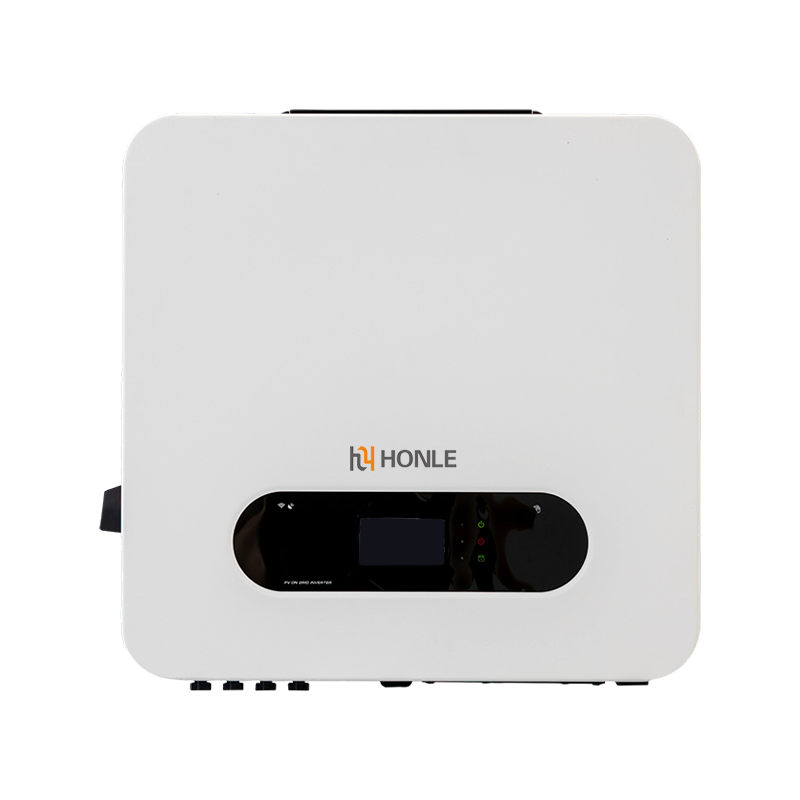
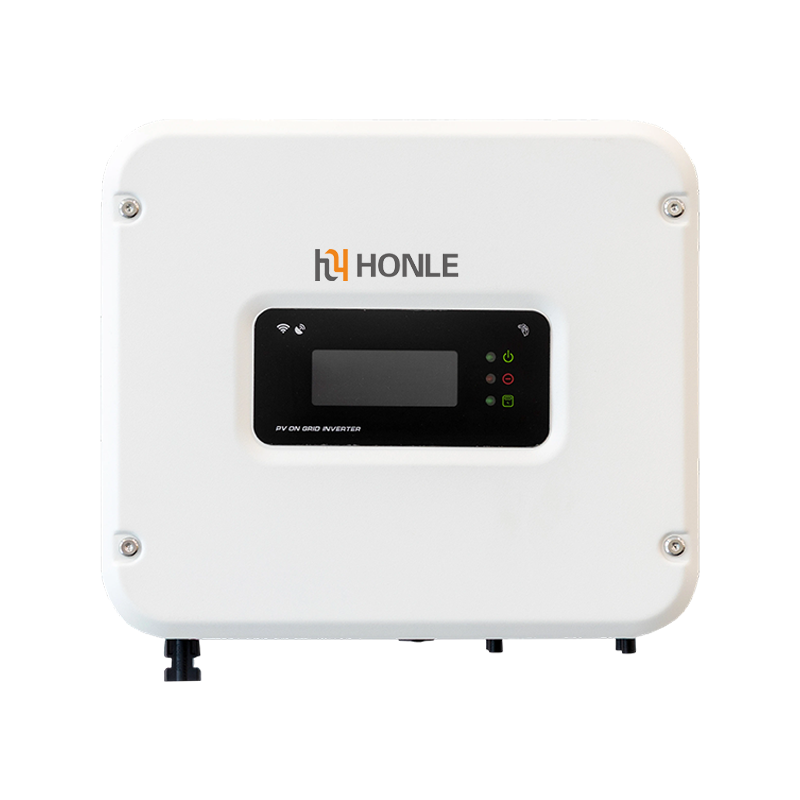
For grid-tied installations, Honle's compact three-phase grid-tied solar inverter is designed for medium-capacity PV systems that need stable three-phase output without a battery.
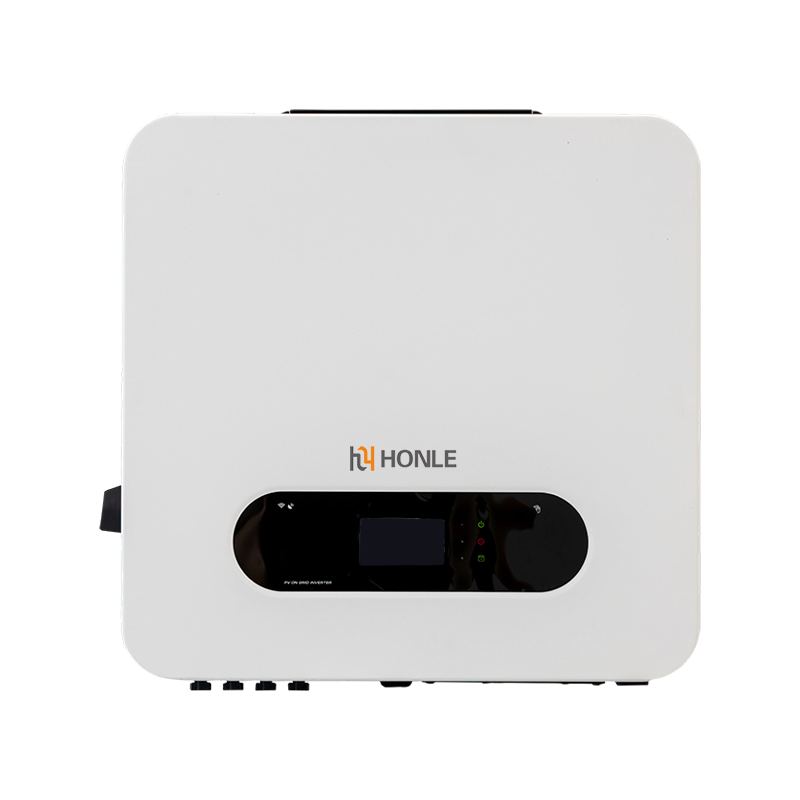 Compact Three-Phase Grid-Tied Solar Inverter for Medium PV SystemsThis lightweight inverter suits medium-capacity grid-tied arrays, offering stable three-phase output, unbalanced load handling, and optional power limiting for export control. Its IP65 design and remote monitoring simplify installation and long-term operation.View Product →
When Should You Use a 3-Phase Solar Inverter?
Start with the grid connection. Open your main distribution board or check your utility meter and look for three live conductors. If the site is already supplied with three-phase power, a 3-phase inverter avoids the need to rebalance the load and keeps the system within the limits of the existing infrastructure.
You should consider a 3-phase inverter when any of the following applies:
- The property has three-phase electrical service and the peak demand is above the single-phase limit set by the local grid operator.
- The solar array capacity is large. In many regions, single-phase inverters are limited to around 5kW to 10kW of export capacity, while larger systems must use three-phase.
- The building has three-phase equipment such as elevators, compressors, large HVAC units, or industrial machinery.
- You are planning a battery storage system where charging and discharging need to be balanced across all three phases.
- The site is a commercial, industrial, or agricultural facility with a load profile that is not balanced on one phase.
For a medium-sized business or a large residential property, the cost difference between a single-phase unit and a 3-phase inverter is often justified by the increased usable capacity. When the grid connection is three-phase, a 3-phase inverter also avoids the tricky problem of adding phase-transforming equipment, which adds cost and complexity.
3-Phase Hybrid Inverter vs Grid-Tied Inverter
There are two main types of 3-phase solar inverters to consider. A grid-tied 3-phase inverter converts solar DC into three-phase AC and feeds that power directly into the grid. It has no battery connection and is usually the most economical choice when the goal is offsetting energy consumption without backup power.
A 3-phase hybrid inverter does the same job but also manages a battery energy storage system. It can store surplus solar energy, export to the grid when needed, and supply backup power during outages. Hybrid models typically provide higher flexibility for tariff optimisation and peak load management.
For storage-based systems, the Honle EPH12KTL three-phase hybrid solar inverter integrates battery management with three-phase power conversion. This makes it suitable for commercial and industrial storage projects where the user wants both self-consumption and reliable backup operation.
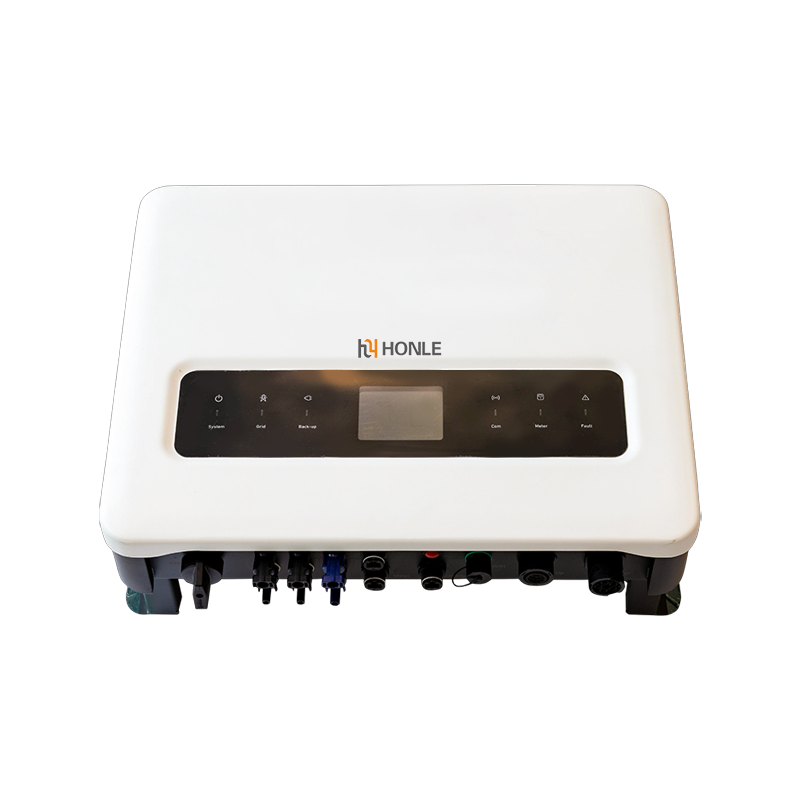 EPH12KTL Three-Phase Hybrid Inverter for High-Capacity StorageFor commercial storage, this hybrid inverter combines battery management with three-phase conversion, supporting high ambient temperatures, multiple battery chemistries, and precise anti-backflow. It enables self-consumption, backup, and grid compliance via advanced controls.View Product →
If you are comparing the two, keep in mind that hybrid inverters cost more upfront but can deliver additional value by shifting energy use away from peak periods and protecting critical loads.
Key Specifications to Check Before Buying
Before you finalise a 3-phase solar inverter, review the following specifications against your site data. These are the areas where a mismatch can cause installation problems or underperformance.
- Continuous power rating (kVA): The inverter must handle the full array capacity and, for hybrid models, the combined charging and discharging power of the battery.
- Number of MPPT trackers: At least two MPPT trackers are useful when panels face different directions or when some strings are partially shaded.
- Maximum input voltage and current: Check the PV string voltage against the inverter's input limits, especially in cold weather when voltage rises.
- Efficiency: Look for both maximum efficiency and European weighted efficiency. Values above 97% are common for modern units.
- Battery compatibility: For hybrid inverters, verify the supported battery voltage range and the communication protocol (usually CAN or RS485).
- Protection class: An IP65 rating or better allows outdoor installation without an additional enclosure.
- Grid certification: The inverter must comply with the local grid standard, such as CE, UL, or G99, depending on the market.
| Specification | Grid-Tied 3-Phase | Hybrid 3-Phase |
|---|---|---|
| Primary function | Feed solar power to grid | Solar plus battery management |
| Battery support | No | Yes |
| Typical efficiency | 98% to 98.5% | 96% to 98% |
| Backup power | No | Yes, with battery |
| Best fit | Commercial PV | Storage systems and microgrids |
If you are selecting a hybrid model, also check the maximum output for off-grid or backup operation. Some hybrid inverters can only supply backup power on one phase or require a specific battery configuration to run in island mode.
Installation and Wiring Considerations
A 3-phase solar inverter must be wired correctly. The three live conductors, neutral, and protective earth (PE) all need to be connected in the right order and with the correct cable size. Here are the points that most often cause problems.
Phase Sequence
If the inverter is used to supply a rotating machine, the phase sequence determines the direction of rotation. Swapping L1 and L2 can reverse the motor direction, which can damage equipment. Always verify the phase sequence with a rotation tester before energising.
Cable and Breaker Sizing
For a 400V three-phase system, the current for a 30kVA inverter is about 43A, which usually requires 10mm² copper cable and a 50A breaker. A 60kVA unit draws about 87A, so 25mm² copper and a 100A breaker are more appropriate. Always follow the manufacturer's table and local electrical rules.
Ventilation and Clearance
Three-phase inverters dissipate more heat than small string inverters. Leave sufficient space around the unit for air circulation, and avoid installing it in direct sunlight unless the product specification explicitly allows it.
Earthing and RCD
Connect the PE conductor properly and check the inverter's RCD requirements. Using the wrong type of residual current device can cause nuisance tripping or fail to operate in a fault condition.
Frequently Asked Questions
Q1: Do I need a 3-phase inverter if my house has 3-phase power?
Not necessarily. If the total load and solar array are small, a single-phase inverter can still work. However, a 3-phase inverter is the safer choice when the home has three-phase equipment or a high demand that would otherwise create an unbalanced load on the supply.
Q2: Can I use a 3-phase inverter on a single-phase grid?
No. A 3-phase inverter is designed to synchronise with a three-phase grid. Connecting it to a single-phase supply will cause a mismatch and may trigger safety protection or damage the unit.
Q3: What happens if one phase is unbalanced?
Modern inverters can adjust the output on each phase, but severe imbalance may reduce efficiency or cause the inverter to derate. During design, spread the loads across the three phases as evenly as possible.
Q4: Is a 3-phase inverter more expensive than a single-phase unit?
Typically yes on a unit basis, but the cost per kilowatt is often lower for larger systems. For projects above the single-phase export limit, a 3-phase inverter is not a luxury - it is the only compliant solution.
Start your selection by checking the incoming supply. Confirm whether your site is connected to a single-phase or three-phase grid, calculate the peak demand, and then match the inverter's continuous power rating to the PV array and battery capacity. For most commercial, industrial, and large residential projects, a 3-phase solar inverter is the foundation for a stable and efficient energy system. When you choose the right hybrid or grid-tied model, you gain reliable power, lower losses, and a design that can grow with your future needs.
Related products
News
-
Your factory has a 400V three-phase supply, the roof has space for 180kW of solar, and your average load sits around 120kW. In that situati...
READ MORE -
A homeowner charges a 1,200W portable power station for two hours before a storm, then runs a refrigerator, a Wi-Fi router and two laptops ...
READ MORE -
A 20-minute outage in July is an annoyance. A 14-hour outage in February, with the furnace blower off, the well pump dead and the sump pit ...
READ MORE -
Honle New Energy Debuts at 140th Canton Fair, Joining Hands with Global Clients to Expand the Renewable Energy Market In October 2026 (Octo...
READ MORE -
At 7 p.m. on a weekday, a typical 8 kW rooftop solar array is producing less than 1 kW. The dishwasher runs, the EV charges, and the househ...
READ MORE

PRODUCTS
LINKS
CONTACT
- Landline: +86-021-56981116
- TEL: +86-13795289200
- Email: [email protected]
- Address: 301-09, Building 6, Zhangjiang Microelectronics Port, No.690 Bibo Road, Pudong District, Shanghai
Copyright © Honle New Energy Technology Co., Ltd.
All Rights Reserved.
Wholesale Solar Energy Equipment Suppliers


This site uses cookies. By continuing to browse the site you are agreeing to our use of cookies. For more details about cookies and how to manage them see our 《Privacy Policy》
Accept